
Top Tip 💡: This guide offers a deep dive into our event mechanics, ideal for facilitators or those curious about the "how." For a general overview, start with our About page.
Event Structure
Our event format is continually evolving to better meet the needs of our participants. Below is the typical structure of a Curious Souls Café event, designed to balance structure with spontaneity.
Initial Welcome
The facilitator introduces themselves and explains the approach: casual, inclusive, and non-academic. The aim is to foster a relaxed space where participants can freely explore ideas.
If it's your first time attending, you’ll receive a welcome leaflet or a link to view it online.

Note: We often adapt based on the group vibe. For example, if Round One is particularly engaging, we might skip Round Two entirely.
Round One: Curated Question Cards
The session begins with participants selecting from a deck of thoughtfully curated question cards. These questions aren’t random prompts; they’re intentionally chosen to spark meaningful reflection while steering clear of overly sensitive topics initially.
The primary goal of this round is to foster genuine connections through personal sharing and build rapport before diving deeper.
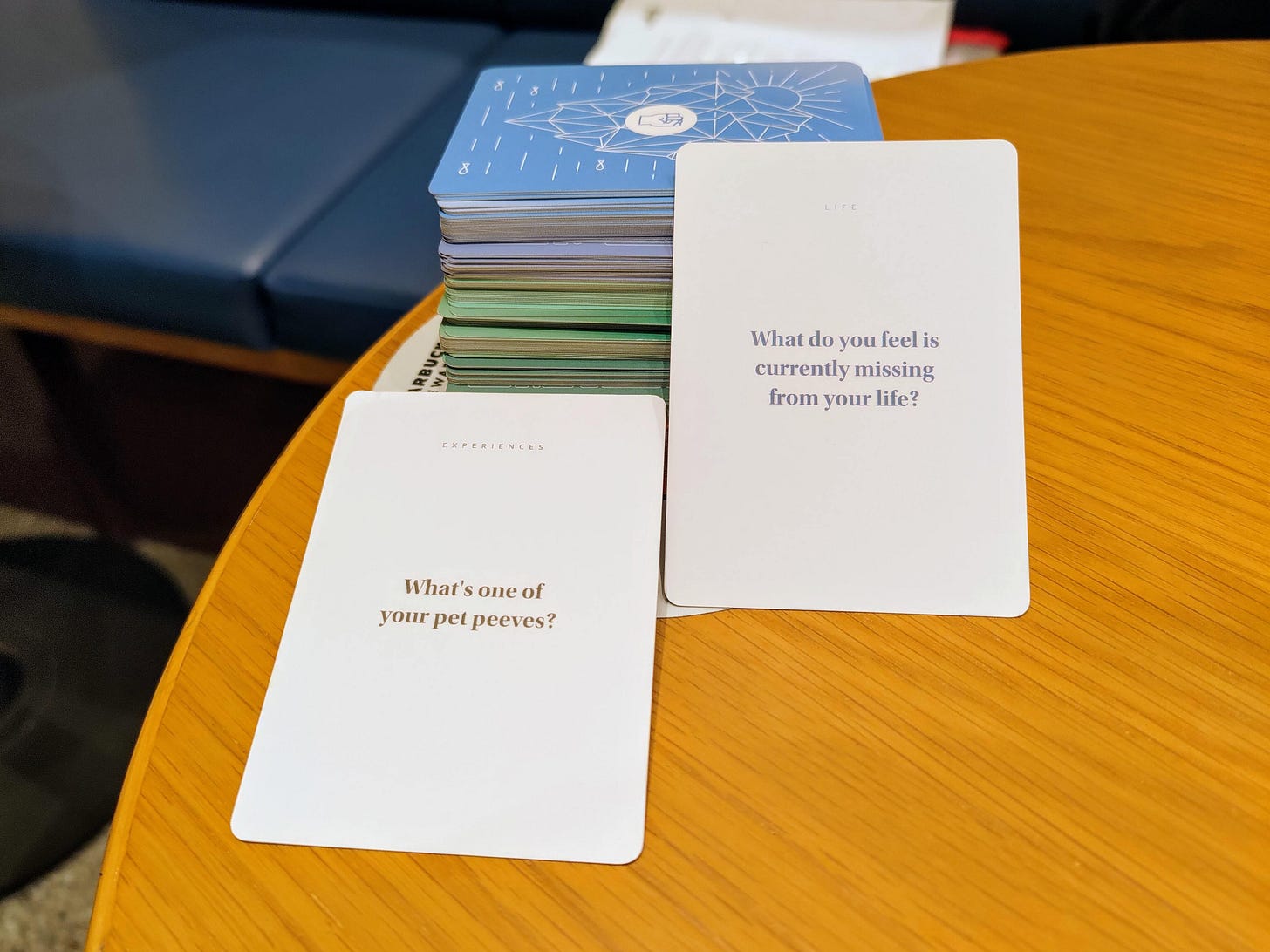
This round can be conducted in several styles depending on the group size:
Style One: Open DiscussionPopular
Participants are invited to draw three cards from the deck. They choose one to present to the group. To enhance bonding, participants can be grouped into teams (e.g., 2–3 people).
The facilitator or group decides which team begins, often using a colorful dice. The person asking the question answers first, followed by others. Passing is always allowed.
Style Two: Paired Discussion
The facilitator presents the group with four cards. Participants independently select one card that resonates with them, then pair up to discuss. Afterwards, pairs rejoin the larger group to share perspectives.
Style Three: Random Reveal
The facilitator reveals a few cards (e.g., four) from the deck at a time. Each participant selects one question to answer. After everyone has answered, a new set is revealed.
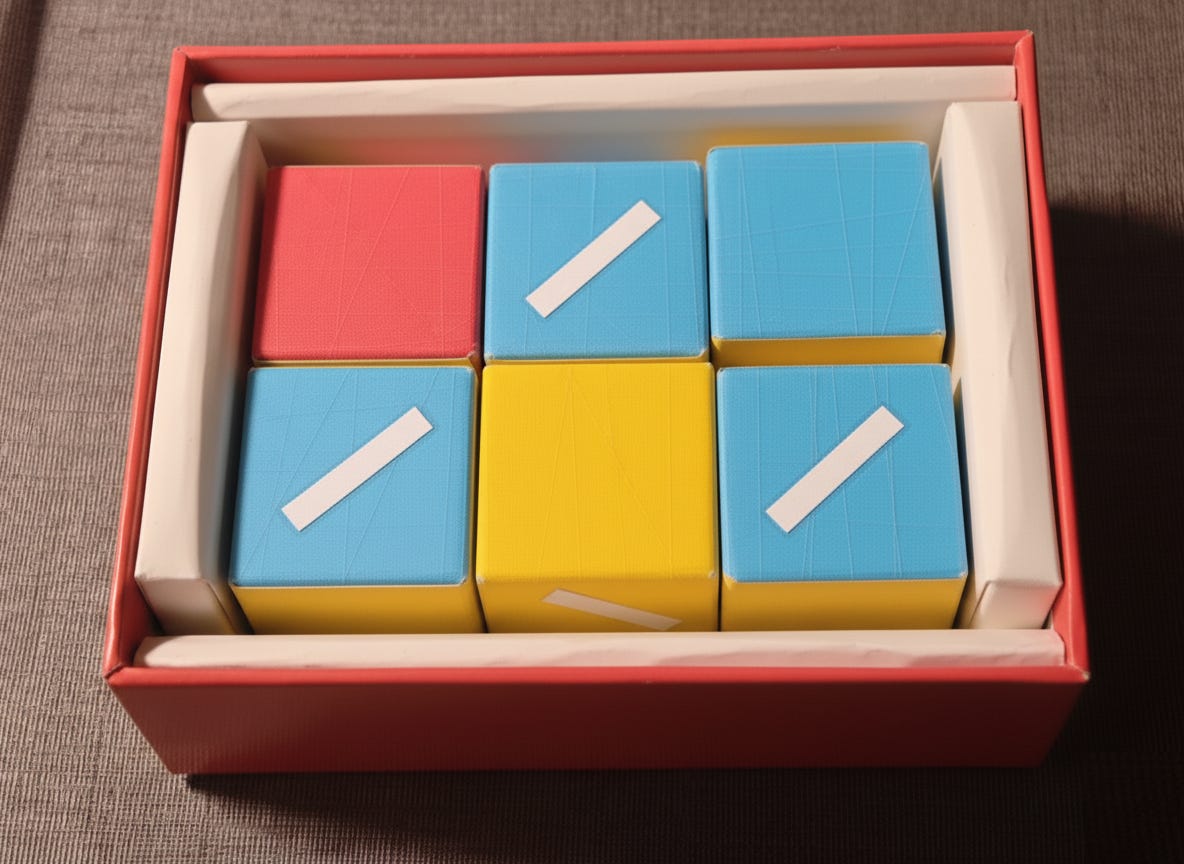
The Dice Decides: Who Starts?
Discover how we use physical dice (or our digital app) to randomly determine the starting speaker. It's a fun way to reduce anxiety.
Round Two: Write Your Own
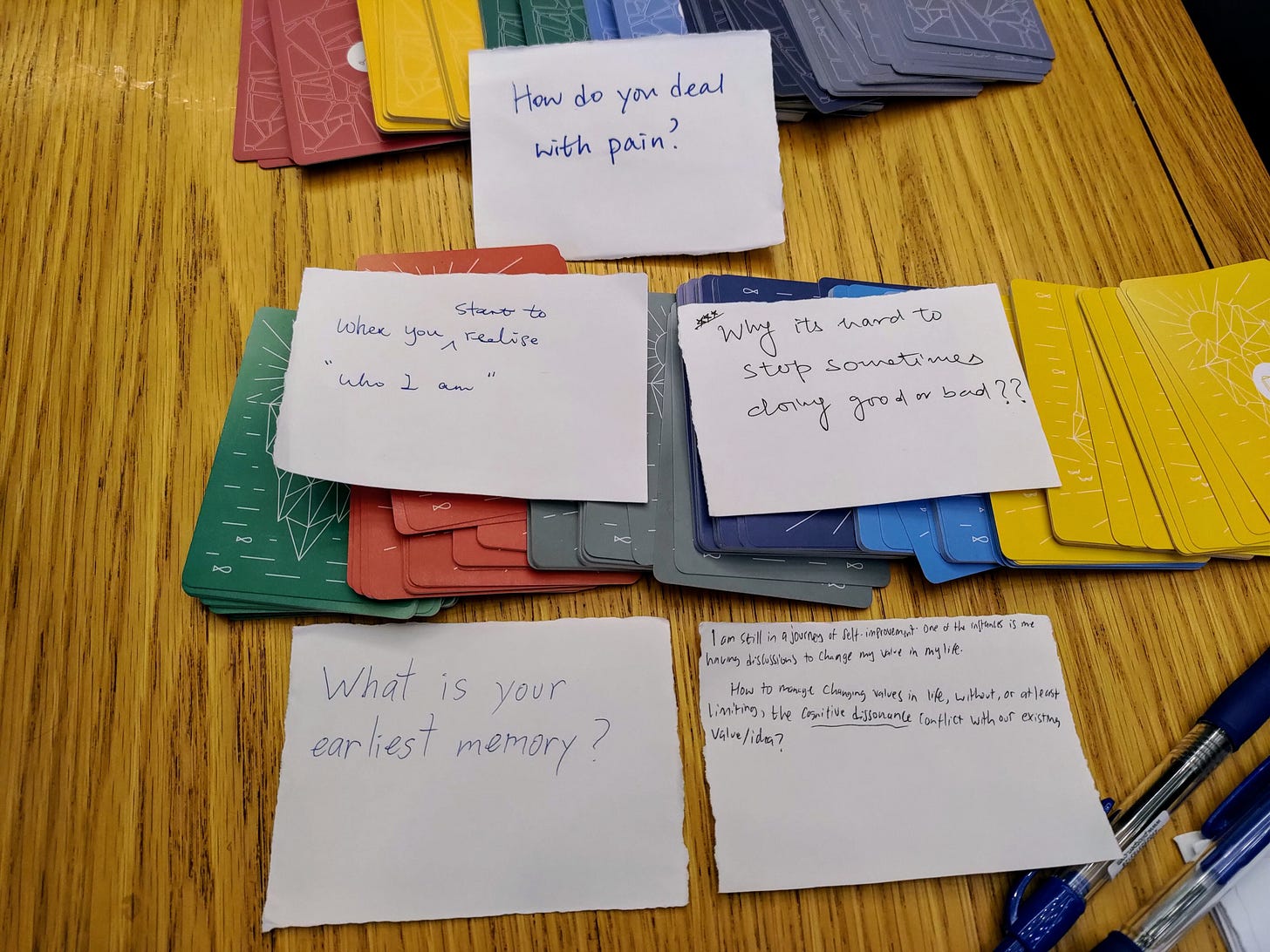
In this optional second round, participants take an active role. It is intentionally less structured to allow for creativity.
Each participant writes down a question they’d like to discuss, inspired by current thoughts or the previous round's conversation. The group then votes on which topics to discuss first.
Format for Larger Gatherings (7+ People)
When attendance exceeds our "magic number" (typically 7+ participants), we utilize a "Breakout to Big Group" format. This structure is designed to manage large crowds while ensuring intimacy is maintained.
1. Color-Coded Teams
The facilitator splits participants into smaller sub-groups (typically 2-5 people) to ensure everyone has a chance to speak. These teams are often assigned colors (e.g., Red, Blue, Yellow) and sit at separate tables or sections to prevent cross-talk interference.
2. Round One: Team Discussion
Instead of individuals choosing questions sequentially, the small teams operate independently during the first half:
- Collaborative Selection: Each team reviews available options (via physical cards or the web app) and negotiates to find one single question they all wish to explore.
- Intimate Dialogue: The teams discuss this chosen question amongst themselves. This allows for deeper engagement as fewer people are competing for airtime.
The Dice Mechanic 🎲: The facilitator may use a colored dice to determine which team starts.
Fun Variation: Some dice have striped sides. If a team's color is rolled with a stripe, the team must collectively perform a "Meaningful Challenge" (e.g., writing a thank you note or giving a compliment) before sharing.
3. Round Two: The Big Reunion
After the breakout sessions, the separate tables merge back together to form one large group for the second half of the event:
- Presentation: Each team presents the question they selected and discussed to the larger group.
- Fair Way to Choose: Since there is insufficient time for 7+ people to discuss every team's question in depth, the group decides (e.g., by using the colored dice) which of the team-selected questions to discuss as a collective.
- Collective Discussion: The whole group discusses the chosen questions, allowing everyone to hear diverse perspectives from people they didn't sit with initially.
Moments of Truth
Regardless of group size, the event concludes with a 5–10 minute reflection session. Participants share their key takeaways, insights, or lessons learned. This cements the connections and ideas formed during the event.
Facilitation Ideas
Facilitators are free to adapt these ideas depending on the flow of the gathering:
- The "Appetizer" Warm-up: Before formal rounds begin, use a simple prompt related to the event's theme (or a simple "check-in" question) to help participants get to know each other and settle in.
- The "Asker Goes First" Rule: To set a tone of vulnerability and allow others time to think, the person who selected or wrote the question should answer it first.
- Gamification with Dice: Utilize a physical or digital dice to randomize who speaks. Variation: Introduce a "striped" side; if rolled, the participant must complete a "meaningful punishment" (e.g., sharing a photo story) instead of standard answering.
- Selection Styles (Round Two): You can choose between Democratic Selection (voting on questions to find the group's interest) or Harmonious Selection (skipping voting to save time and simply moving sequentially or randomly).
- Visual Cues: To manage interruptions or focus, have the active speaker hold a specific object (such as a green question card) while they are talking.
- "Pause and Reflect": Instead of simply discarding questions that weren't discussed due to time constraints, save them for a dedicated future session focused on these "leftover" topics.
- Active Management: In larger groups, facilitators may need to actively manage time to ensure everyone contributes, gently circling back to quieter members.
- Ending a Discussion: If the energy feels unresolved, ask: “Does anyone have further thoughts before we move on?”
Make Your Own Question Cards
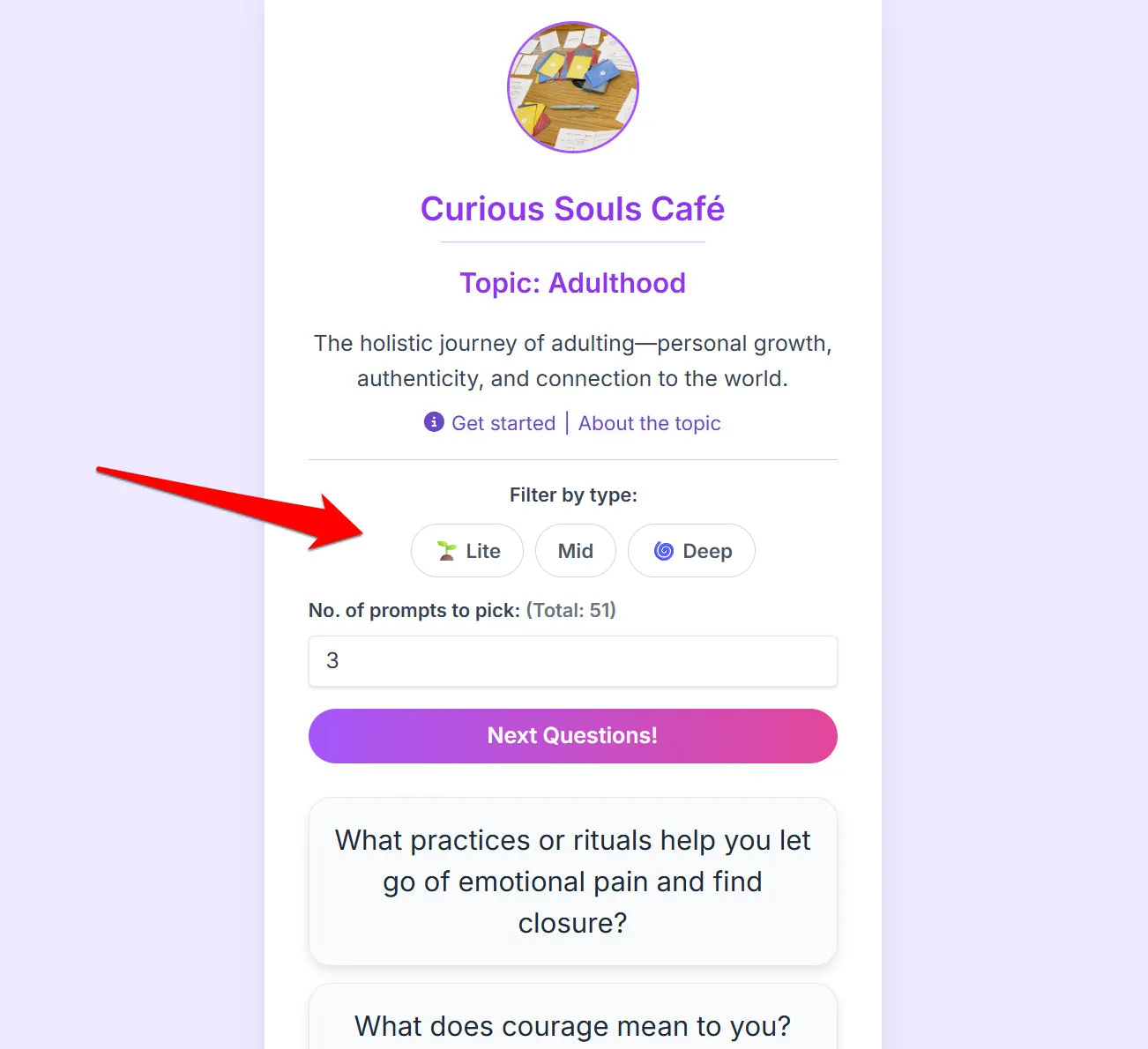
Facilitators may create custom question cards with our Deck Builder to fit a specific event theme. Questions can be categorized into levels:
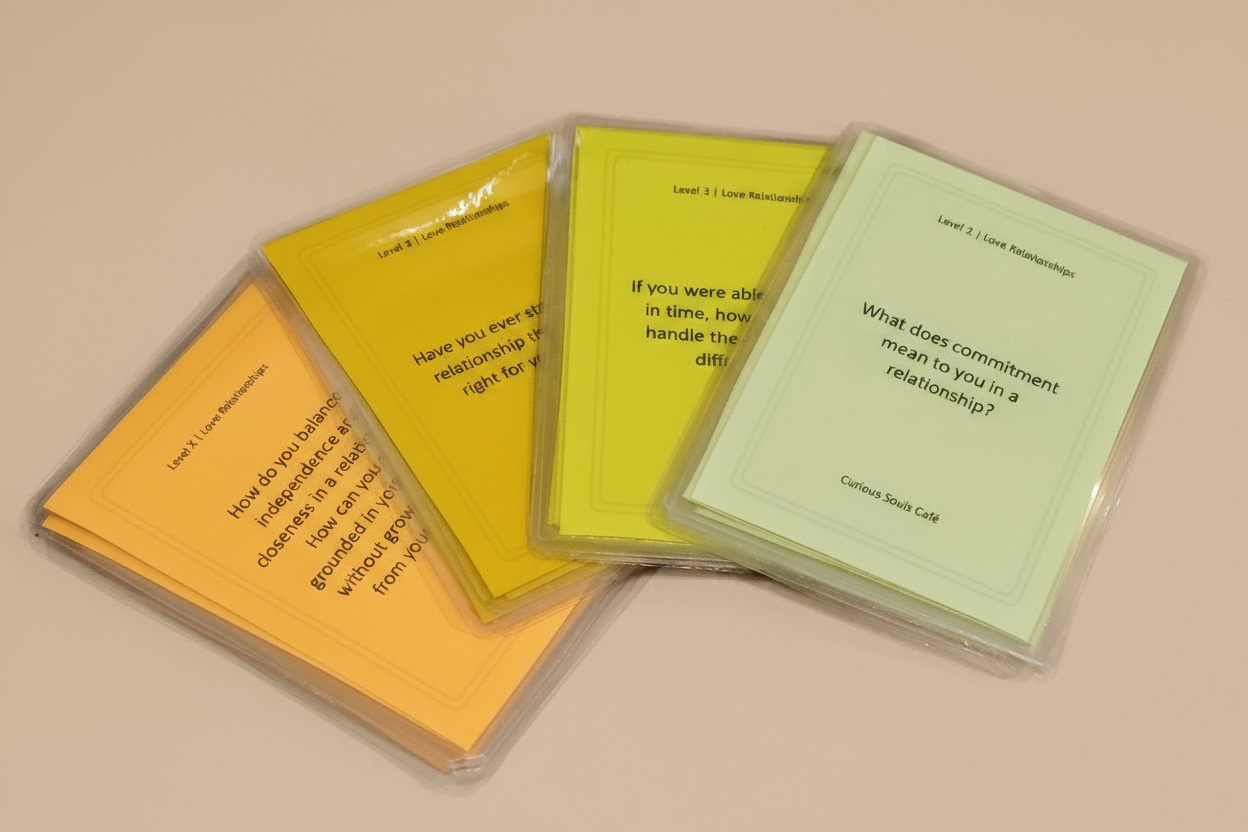
- Level One: Light questions to ease participants in. 🌱
- Level Two: Mid-level questions requiring more reflection. ☕
- Level Three: Deep, thought-provoking questions. 🌀
On the web app, this can be achieved by using the type filter within any topic page.
Ready to Facilitate?
Now that you know how the event works, we have built a free digital companion to help you run it smoothly.

Your Digital Pocket Facilitator
Access our full suite of free tools: curated conversation decks, dice roller, the deck builder, and live session boards.
Ready to join a discussion? Find an event near you.